MA Fine Art and Education. Workshop Saturday 6th February.
Baltic workshops ; as an alumni I am asked back to teach on the wonderful Saturday workshops, it is a real pleasure to work with the students and other invited artists. The sessions often have a theme and always result in discussing pedagogy. The theme was ‘Dialogue within a critical Pedagogy’ the course is wonderfully run by Judy Thomas. She invites many people to present their work and ideas at the sessions.
The next session to mine was being run by Jane Arnfield! Her work is astonishing. I have included some of her work in a link here.
Zdenka Fantlová is one of a handful of Holocaust survivors still alive today.
This is her story, born in Czechoslovakia Zdenka was 17 when the war began and the ring of the title was given to her by Arno her first love. Zdenka kept it with her as a symbol of truth and hope from Terezin to Bergen-Belsen.
Adapted for the stage by Mike Alfreds & Jane Arnfield, directed by Mike Alfreds ‘The Tin Ring’ is a profoundly uplifting story of great love, brought to life by Jane Arnfield’s extraordinary solo performance.
Memory needs a structure and prompts to help recall. I have found some prompts in my Stairwell Conversations to be amazing keys, unlocking a set of very rich resources for us to use in current work.
I am mindful that I am very keen for my prompts to be physical, to be of materials and making. Following on from the Mapping week at the start of the year, I gave the MA Fine Art and Education students a workshop also based on the Marshall Islands Navigation Charts. I devised this workshop in September as part of our Charette week.
The task is simple but it ignites the imagination! I asked the students to think of their own practice and make a stick chart showing the fixed points and the fluid points in their current work. The results were extraordinary. The stick charts are really an allegory for elements of work and methods, everyone was absorbed and narratives will be unpicked at length. This activity prompts very complex personal reflection and was very transferrable from school to the Postgraduate course!
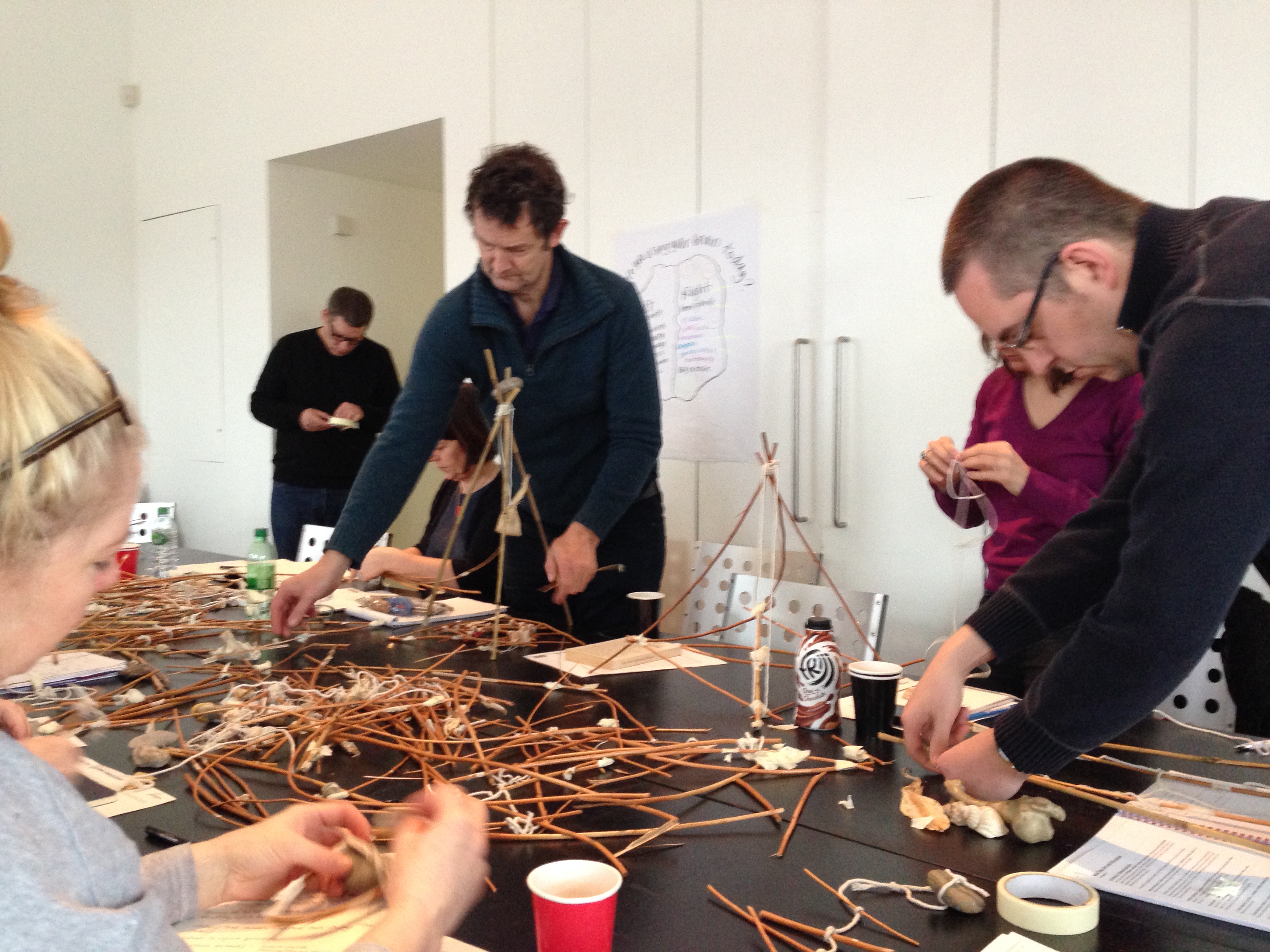
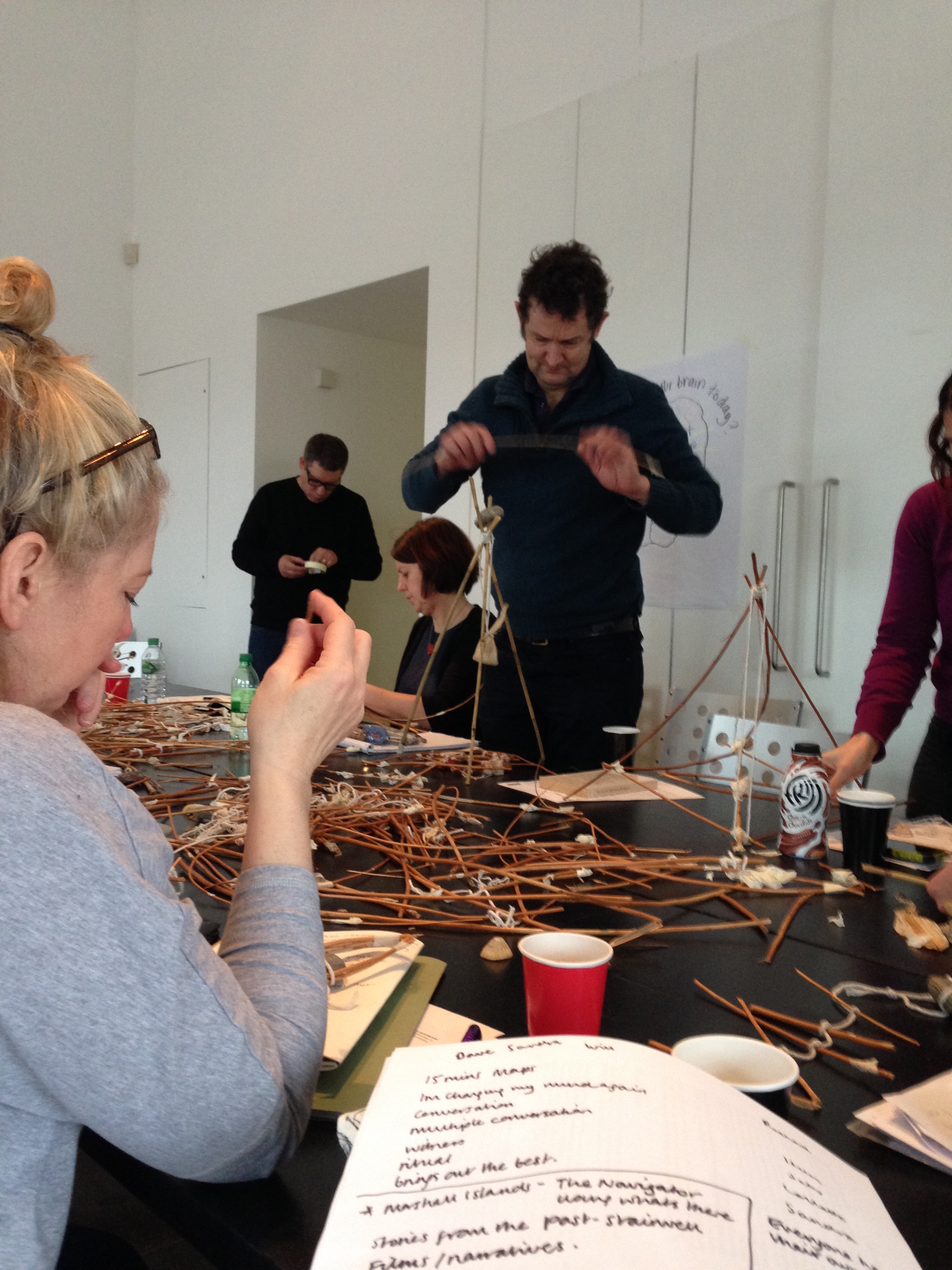
Making things allows us thinking time and making things in a group is a very profound experience. The materials are recycled and were indeed undone for recycling at the end of the session.
I value the power of working together in a group where materials are simple and the possibilities are strikingly challenging and profound. for most of the session, as at school, the students were silent, intense concentration on the task. there is a magic about natural materials, sticks, shells, stones, string.
Activity that brings people together has political power and is individually empowering.
I am mindful of Suzanne Lacey’s work that I saw in Tate Tanks during the summer of 2012.
-
 Suzanne Lacy
The Crystal Quilt 1985–7© The artist Photo: Gus Gustafson
On 10 May 1987 in Minneapolis, 430 women over the age of 60 gathered to share their views on growing older. The resulting performance, The Crystal Quilt, was broadcast live on television and attended by over 3,000 people.
It was the culmination of the Whisper Minnesota Project, a three-year public artwork empowering and giving a voice to older women. The process was consciously guided by a desire to represent diverse ethnic and social backgrounds alongside life experience and achievements, forming an active comment on the representation of older women in the media. Lacy has stated: ‘In some sense The Crystal Quilt was successful politically, in that the work was bigger, it had more social impact in that region, but do one or two events ever change the way people – other than those who directly experience it – see? This raises this issue of whether you can expect art to create social change, and at what point is it no longer art.’
The Crystal Quilt now exists in the form of a video, documentary, quilt, photographs and sound piece, combining the original elements of performance, activism and broadcast in an ambitious work that fuses social responsibility with the power of aesthetics: something Suzanne Lacy has pioneered in her long career as activist artist, writer and teacher.
The Crystal Quilt took place at the IDS Center Crystal Court, Minneapolis, and was broadcast by KTCA television. Suzanne Lacy collaborated with Phyllis Jane Rose, Miriam Schapiro, Nancy Dennis and Susan Stone.
Suzanne Lacy (born 1945, USA) has worked collaboratively with artists and communities since the 1970s. In 1991 she founded TEAM (Teens + Educators + Artists + Media Makers) with photographer Chris Johnson and producer Annice Jacoby. A writer she edited the influential Mapping the Terrain: New Genre Public Art in 1995, a book that prefigured much current writing on politically relevant performance art. Lacy was Dean of the School of Fine Arts at the California College of Arts from 1987 to 1997, between 1996 and 1997 she co-founded the Visual and Public Art Institute at California State University at Monterey Bay with artist Judith Baca, and in 1998 she became Founding Director of the Center for Art and Public Life. She is currently the Chair of Graduate Public Practice at Otis College of Art and Design in Los Angeles.
Part of the series The Tanks: Art in Action
 artistteachercef